Why Aged Basmati Changes Everything
Most supermarket Basmati is less than a year old. Here's why aged Basmati — the kind used across India for biryani — tastes so much better, and how to spot it.
If you've made biryani with supermarket rice and wondered why it turns out sticky and clumped together, the answer is almost certainly the rice itself.
What "aged" actually means
Basmati rice is harvested once a year. Freshly harvested rice has a high moisture content — around 14–16%. When you cook it, the excess moisture causes the grains to stick together and lose their distinct shape.
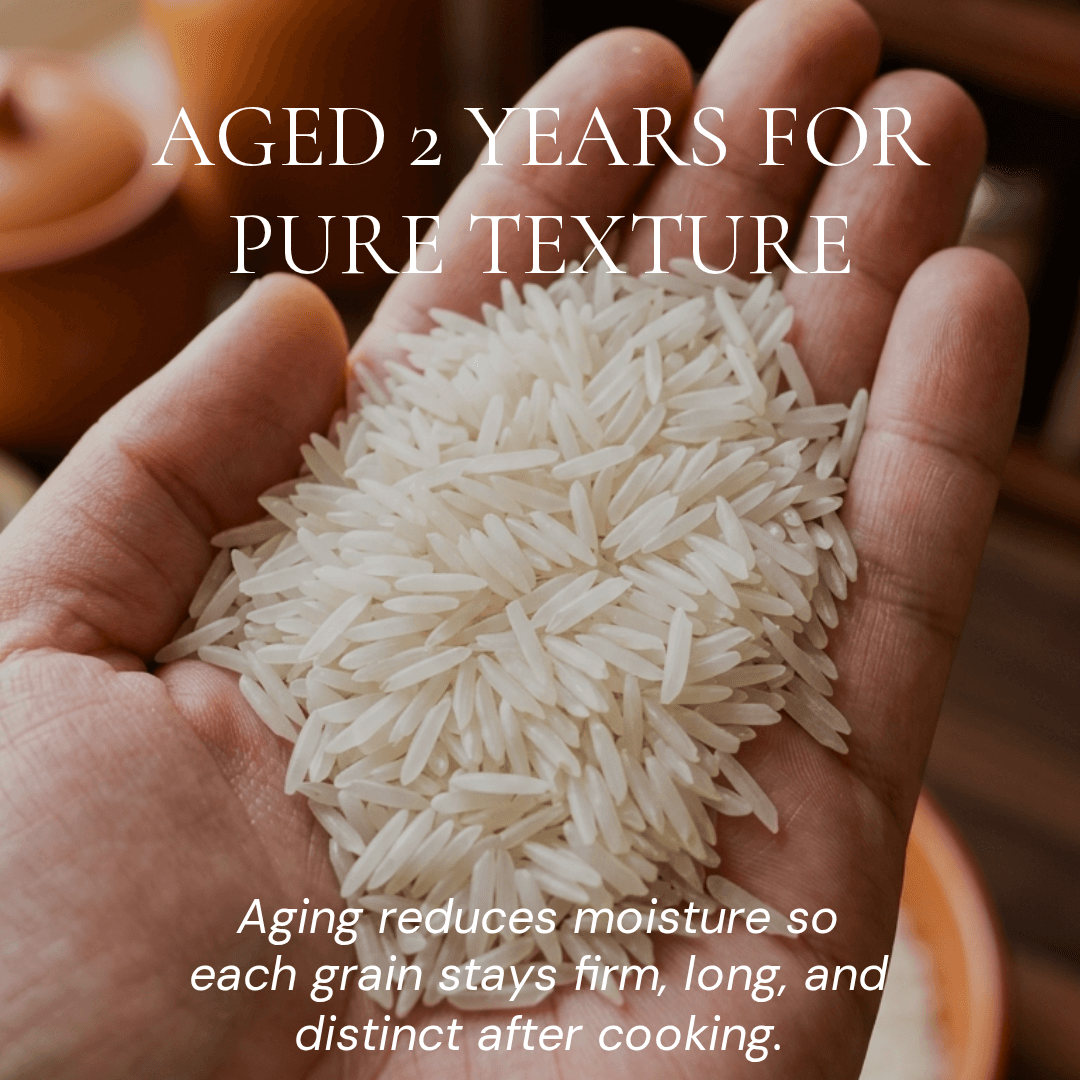
Aged Basmati (typically 1–2 years old) has dried out to a moisture content of around 10–11%. This lower moisture means the grains stay separate when cooked, elongate dramatically (good Basmati should nearly double in length), and absorb flavour more evenly.
The aroma difference
The signature floral aroma of Basmati — that faint smell of pandan or popcorn — intensifies during aging. This is due to the conversion of a compound called 2-acetyl-1-pyrroline (2-AP), which concentrates as moisture leaves the grain. Budget rice skips the aging step entirely.
How to tell aged rice at a glance
When you open a bag of aged Basmati, the grains should be:
- Long and slender — at least 7.5 mm before cooking
- Slightly translucent — not chalky white throughout
- Dry to the touch — no clumping in the bag
- Fragrant even before cooking — a faint nutty, floral scent
If the rice looks short, chalky, or smells of nothing, it hasn't been aged properly.
What we stock at Aahaar
We source aged Basmati — the same varieties used by home cooks across Punjab and Hyderabad — because we cook with it ourselves. The difference is immediately obvious in a biryani or pulao.
New to Aahaar? Your first order over €40 ships free. No subscription, no commitment.